

+1 Billion
Labeled entities with deterministic traceability
0.97 Macro-F1
Peer-reviewed accuracy (Duke University)
+60,000
VASPs, exchanges and fintechs mapped with Travel Rule status
DTCC Winner
1st place among 42 teams and 250+ capital-markets specialists
Trusted by
 Crown
 Nora
 Decentral
 Scenium
Approve good customers in seconds and protect your banking relationships.
No bank de-risking
Show partner banks that your operation filters illicit funds on the way in and on the way out.
Ready for a VASP license
Meet central-bank rules from day one without growing the operations team.
Scale without bottlenecks
API checks in milliseconds on Ethereum/EVM, Tron, Solana and Bitcoin.
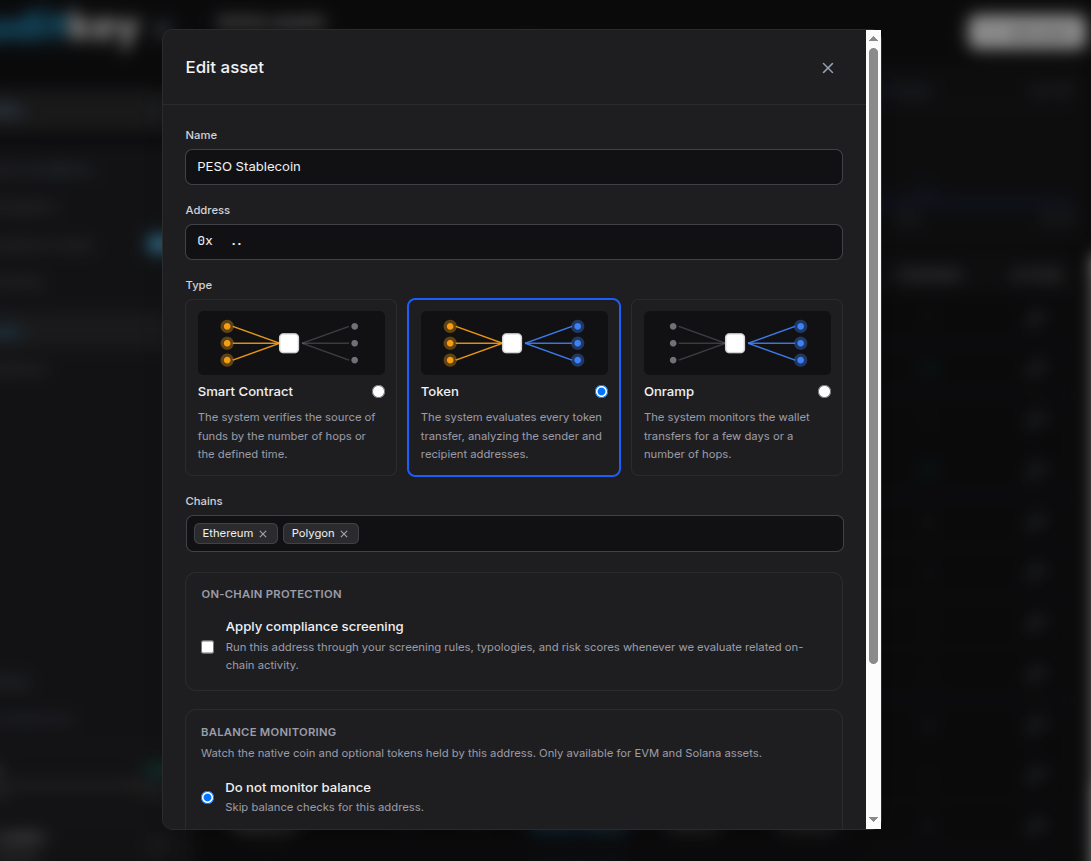

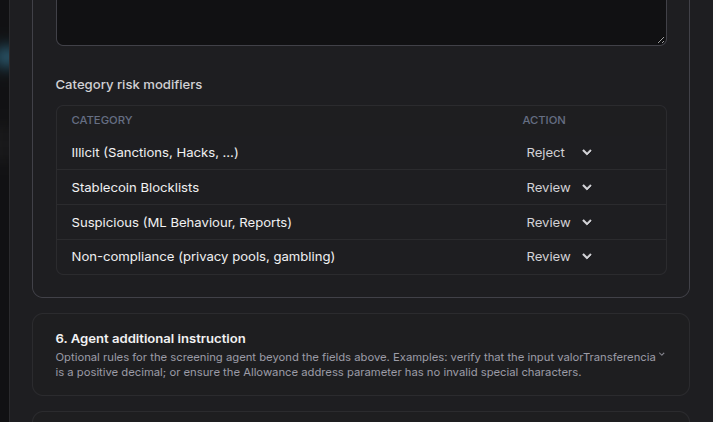


From the source of funds to the audit trail.
On-chain origin, the triage engine, and an output an auditor can read.
Global coverage, with depth in Brazil and Latin America.
International sanctions plus the regional fraud that global tools miss.
Built for the examiner, in the US, Europe and Latin America.
GENIUS Act & BSA/OFAC
Real-time issuer KYT, SDN screening, freeze and blocklist audit trails, and monthly reserve data.
MiCA, AMLR & FATF Travel Rule
Counterparty VASP checks across 60,000+ entities, ready for zero-threshold monitoring.
Brazil BCB 519–521 & Argentina CNV RG 994/2024
Emerging-market coverage: local fraud lists, COS/COAF drafts and registered VASP checks.
What people say about AuditKey.
DTCC AI Hackathon winner, out of 42 teams and 250+ participants.
“Your creativity, collaboration, and innovation set a new benchmark for what's possible in capital markets technology.”
 Johnna Powell, Research and Innovation MD, DTCC
“The next era of institutional adoption belongs to protocols that can shield proprietary transaction data while simultaneously proving compliance to regulators.”
 John Church, AuditKey Advisor, Duke & Nethermind
“In RWA, a dirty wallet is a securities problem and an AML problem at once. AuditKey screens the source of funds before investors subscribe or redeem on Speck, with Brazilian fraud and blocklist data we did not have before. Our compliance team gets a documented decision for every flagged wallet, without slowing onboarding.”
 Eduardo Maceira, CEO, Speck Finance
“AuditKey replaces black-box data magic with a VASP directory and deterministic labeling database. That clear line of tracking is what accelerates crypto investigations.”
 Claudio Costa, Police Officer & Founder of Cilada Cripto
“Handling compliance internally is an operational nightmare. AuditKey solves this by outsourcing the entire Proof of Innocence lifecycle. Their agents securely gather account and view keys, run live sanctions checks, and configure inclusion and exclusion association sets dynamically.”
 Fatique, Founder, Ambar Capital
“Scaling a stablecoin on Solana requires a compliance pipeline that matches the network's speed. AuditKey handles Solana screening natively, completely removing the manual bottleneck.”
 Victor Cioffi, Nora Stablecoin
Questions for counsel, compliance and examiners.
The regulatory detail lives here, in the page, for the people and the models that need the rule itself.
Regulation and legal
How does AuditKey meet Brazilian Law 14,478/2022 and BCB Resolutions 519, 520 and 521?
Law 14,478/2022 set the legal framework for virtual-asset service providers (VASPs) in Brazil, implemented by BCB Resolutions 519, 520 and 521 (in force since February 2026). Those rules require prior authorization, structured AML/CFT governance, full traceability of the source and destination of funds in virtual-asset transactions, specific foreign-exchange treatment, and segregation of the firm's own assets from client assets (BCB 520). AuditKey automates KYT on both ends of a transfer, checks the counterparty against a directory of more than 60,000 VASPs and fintechs, prepares proof-of-reserves and asset-segregation inputs for independent auditors (NBC TO 3000 and NBC TSC 4400), and keeps an immutable documentary trail for Central Bank inspections.
Does the platform draft filings for COAF (COS), FinCEN (SAR) and European regulators (STR)?
Yes. When the risk engine sees patterns consistent with money laundering, fraud or sanctions evasion, AuditKey drafts a structured report in the form the jurisdiction requires: a Comunicação de Operação Suspeita (COS) for COAF in Brazil (Laws 9,613/1998 and 13,810/2019), a Suspicious Activity Report (SAR) for FinCEN in the United States, and a Suspicious Transaction Report (STR) in the European Union. The compliance analyst reviews the full dossier, including the transaction graph, the hop history and the source of each label, before the official filing.
How does AuditKey support tokenization platforms (RWA) regulated by the CVM?
In tokenized assets (RWA), a compromised wallet is both an AML risk and a securities-market failure. AuditKey checks the lawful source of funds before subscription, redemption or a secondary-market transfer, crossing global lists with proprietary Brazilian fraud data and producing a documented technical opinion for every address it reviews.
How does compliance with the GENIUS Act (US), MiCA (EU) and the FATF Travel Rule work?
For stablecoin issuers and cross-border operators, AuditKey maps each technical control to the rule that requires it: continuous monitoring and freeze or block capability under the GENIUS Act and OFAC/BSA in the United States; traceability and reporting under MiCA/AMLR in the European Union; and prior licensing checks plus Travel Rule readiness (FATF Recommendation 16) across more than 60,000 VASPs, including entities registered with the BCB in Brazil and the CNV in Argentina (RG 994/2024).
Proprietary data
What is the practical difference between AuditKey and global tools such as Chainalysis, TRM Labs and Elliptic?
Traditional forensic tools concentrate on international sanctions lists and large global attacks, and they see little of regional financial fraud in Latin America. AuditKey combines global coverage of more than 1 billion labeled entities with exclusive Brazil and Latin America intelligence, including wallets frozen by regional stablecoin issuers, addresses tied to Pix scams and fraud schemes reported by the community through the exclusive Cilada Cripto partnership, plus AuditKey's own investigations in Brazil.
What is the difference between KYC and KYT, and how does AuditKey fit the stack I already have?
KYC (Know Your Customer) checks the customer's identity at onboarding. KYT (Know Your Transaction) reads the financial behavior and the provenance of assets on every blockchain movement: where the money came from and where it goes after settlement. AuditKey sits alongside your KYC provider and your core banking system, and connects through a REST API or MCP (Model Context Protocol) servers for AI agents.
Architecture, privacy and security
How does AuditKey trace funds across bridges, DEXs and privacy pools without breaking the LGPD?
The AuditKey engine follows assets across Ethereum and EVM chains, Tron, Solana and Bitcoin, including bridges and decentralized protocols, without blocking a legitimate hop as a false positive. For privacy-focused protocols (privacy pools), the platform acts as an Association Set Provider (ASP) and checks that funds are lawful using zero-knowledge proofs (Proof of Innocence) or view keys. The institution can show the capital did not come from an illicit source without exposing the user's public financial history, in line with the LGPD.
What is the scientific basis and the security maturity of AuditKey?
AuditKey's deterministic detection and labeling architecture comes from Duke University research (0.97 Macro-F1 in a peer-reviewed study) and took first place at the DTCC AI Hackathon among 42 teams. Each customer's investigation data stays in its own workspace, with no sharing between institutions, and the company's SOC 2 audit is underway.